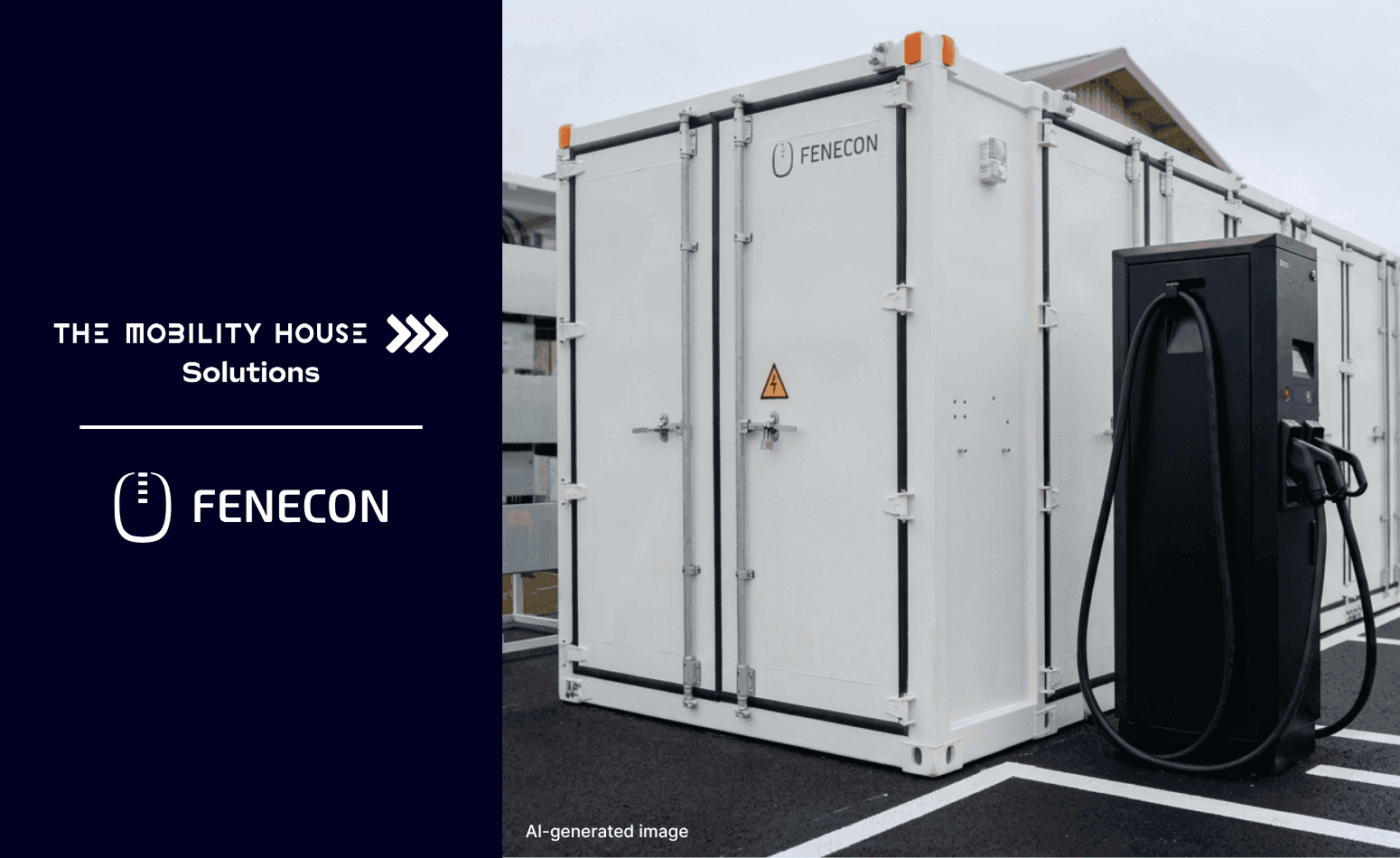
As electric mobility accelerates, many charging sites are facing a new kind of challenge. The question is no longer just how to install individual charging points, but how to operate and scale entire sites profitably. Whether at a company site, a logistics depot, or a public fast-charging hub, the grid connection is increasingly the ceiling that limits further expansion. That’s driving demand for solutions that manage energy flows more flexibly and get more out of available grid capacity.
Energy Storage and Charging Infrastructure, Working in Sync
Scaling a charging site under a constrained grid connection requires two key levers: flexible energy use and intelligent control of the charging infrastructure. In response, FENECON and The Mobility House Solutions are joining forces, combining their respective strengths in energy storage and charging technology.
FENECON's stationary energy storage systems and its energy management system FEMS optimize how energy from all available sources – grid connection, solar, and beyond – is used on site. By decoupling when energy is drawn from when it's consumed, energy storage adds a layer of flexibility: locally generated solar power, for example, can be stored and made available for charging later in the day.
The Mobility House Solutions' ChargePilot handles the load management side. It runs the day-to-day charging operation, dynamically distributing available power across connected charge points while factoring in each vehicle's actual charging needs and prioritizing accordingly.
The two systems operate with a clear division of responsibilities: FEMS defines the available power budget; ChargePilot puts it to work intelligently across the charging infrastructure. This matters particularly at larger sites, where multiple systems and controllers from different vendors often coexist. The coordinated interplay between energy management, energy storage, and charging infrastructure helps reduce that complexity, enabling more stable and scalable operations.
"Many operators are hitting the limits of their grid connection as they try to expand their charging sites. ChargePilot lets us manage charging infrastructure in a way that avoids costly grid upgrades and reduces operating expenses. Combined with energy storage, that control reaches its full potential – which is exactly why we're so excited to be working with FENECON."
Heiko Bayer, Managing Director,
The Mobility House Solutions
Doing More With the Existing Grid Connection
For charging site operators, the combination of energy management, energy storage, and load management primarily translates into better economics. The well-matched pairing of the two systems also supports faster deployment and easier scaling of charging projects. At the same time, the solution contributes to grid stability more broadly: By better balancing energy flows on site and shaving peak loads, it helps lay the groundwork for continued EV growth.
"We're proud of this partnership with The Mobility House Solutions. It's been technically rewarding from day one, and we've already delivered a number of projects together. Our joint solution, combining FEMS and ChargePilot, improves the bottom line while reducing complexity. We know that every energy system evolves over time — what we call the customer's Energy Journey — and it's a core priority for us to be active guides on that journey, with a deep understanding of the regulatory landscape and the current and future possibilities in our home market of Germany."
Franz-Josef Feilmeier, CEO,
FENECON GmbH